A recurring question is whether the use of polyphosphates to prevent limescale formation is recommended or not for water intended for human consumption.
For water at room temperature or cold, few problems
Phosphates are not mentioned in drinking water regulations and do not have parameter values as they do not generally pose any particular toxicity problems. International literature also does not indicate any limit values for phosphate residues that can be measured in water softened with the addition of these compounds. The only values are for the parameter “phosphates”, which give a permissible daily intake of 40 mg/kg body weight (= 280 mg for an adult weighing 70 kg). With the exception of infants up to 16 weeks of age, phosphates, including those used as food additives, are considered non-toxic.
Therefore, the amount of polyphosphates, residues from a water softening process, would in any case be negligible, provided that the dosing system is truly proportional and manages a low release. There are no specific European standards, while in the USA, the NSF 60 standard indicates a maximum concentration of 10 ppm.
The use of polyphosphates is not recommended for hot water
Whilst hot water from a filter that uses polyphosphates is not considered drinkable and should not be drunk or used for food preparation purposes
The main reason is related to the degradation of polyphosphates at high temperatures:
- Polyphosphates tend to hydrolyse (break down) into orthophosphates when heated.
- Although polyphosphates themselves may be of food-grade purity, the resulting orthophosphates, in certain concentrations and conditions, may have health effects or are otherwise not authorised for human consumption under those specific conditions.
- In addition, high temperatures and prolonged water residence time in pipes can promote the release of heavy metals (such as copper and lead) from the pipes, making the water unsafe for consumption. Polyphosphates themselves, by inhibiting limescale, can promote interaction between water and metals.
For these reasons, polyphosphate dosing systems are usually installed only on the cold water line leading to the boiler or specific appliances (such as washing machines or dishwashers), excluding contact with water intended for consumption.
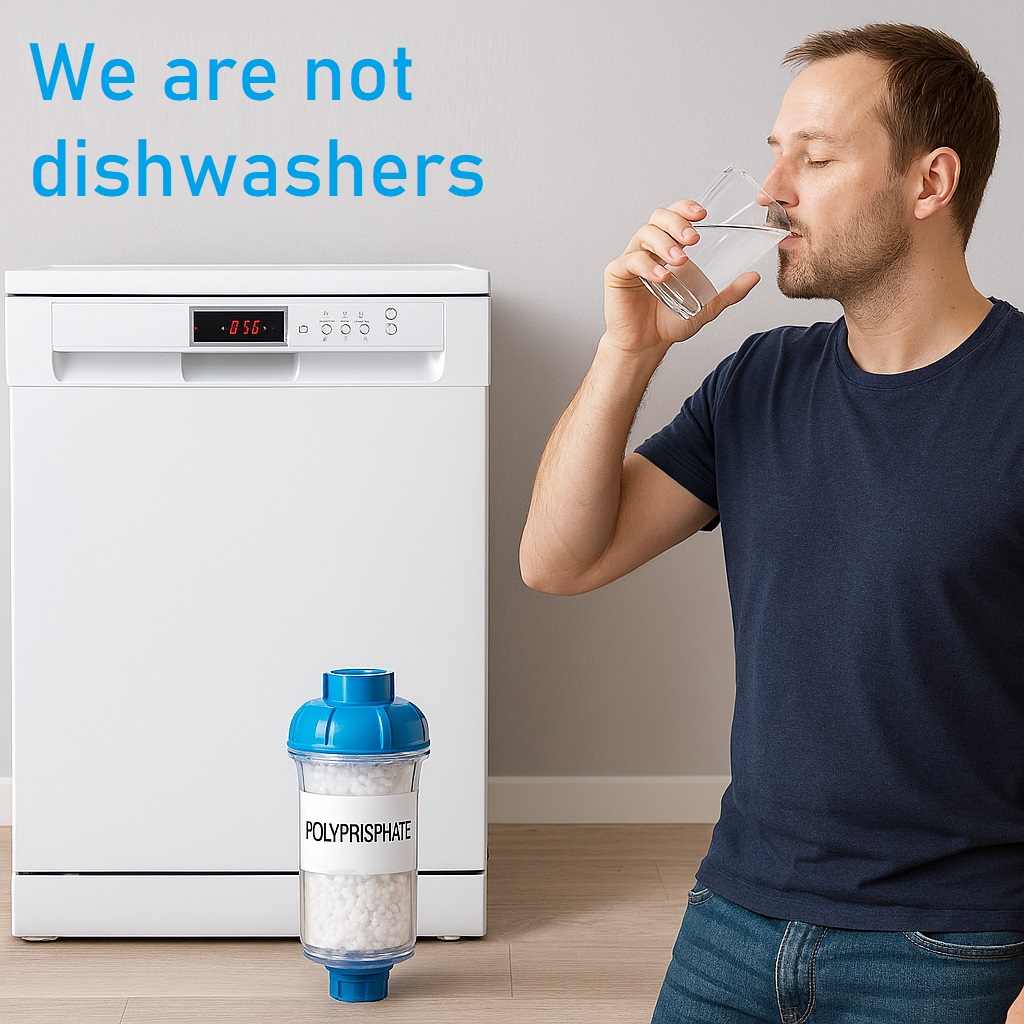
The bad practice of inserting polyphosphate filters into drinking water treatment systems at the point of use.
For reverse osmosis systems, there are no particular problems with installing a polyphosphate filter downstream of the system to protect the system itself. As we have seen, they are not harmful at room temperature and serve to protect the membranes.
Polyphosphate filters should not be used in cold and hot water dispensers, or rather, the hot water circuit should not use them. There are various solutions, all of which are accessible.
Since the quantity is not regulated, the simple and economical solution is to use ultra-economical devices that release high quantities without any monitoring. While this may be fine for a dishwasher, it is certainly not recommended for human health.